
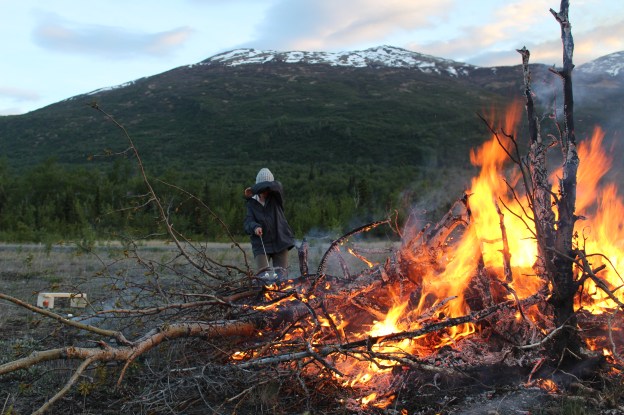
Things have been very hot in Alaska. There has been a tragic fire just north of Anchorage. Things are too hot. The same thing happened at my church’s coffee shop campus. Twelve-one-hundred caught fire. That is an exaggeration. The mulch caught fire. I spent my Saturday afternoon spraying down the mulch and turning it over. The heat is getting to me.
In this installment of my mission to record all the commands in scripture, the heat will get to the Israelites. The ex-slaves can’t handle this Yahweh-god. He is too strange for them. He isn’t controllable like the other gods. By the end of it all though, God will command them to build a tent just for him. Ready or not, God will dwell with his people.
Exo 30:23, 34 “Take the finest spices: of liquid myrrh… cinnamon… aromatic cane… Take sweet spices…” Everything before this has been the same future-tense commands as the Ten Commandments. The people aren’t stationary yet. They aren’t building an altar of incense or taking a census of all the land. But they do have olive oil and spices, so they can begin consecrating things now. This is a metaphor for how we should live our lives. God does have big beautiful plans for us. We may one day build altars and survey far off lands. But today, we can claim what is around us as holy. We have the common things, the everyday things, oil and spices. Holiness is for today, not for the some-day.
Exo 31:2 “Look! I have called by my name Bezalel.” The command is for Moses to “look.” God is calling Moses to see the reality of what he has done. He put his Spirit on the artisan. Artistic talent, inspiration, is miraculous. The God of the slaves is not above being a muse, but he is a muse in control.
Exo 31:13 “Speak to the people of Israel…” The instruction for the people is “You shall keep my Sabbaths” but the actual command is for Moses the prophet to speak to God’s people. I am curious to know how the people heard this. We think about Sabbath regulations as ancient and a given, but for these people they were new. When God said, “It is a sign forever,” he was saying a new thing to these people.
Exo 32:7, 10 “Go down… let me alone, that my wrath may burn hot, that I may make a great nation of you.” Moses is commanded to go down the mountain so that God can charge his laser cannon and blast the idolatrous people. The golden calf caused this moment of great testing for Moses. Abraham was tested by a knife and the life of a son dumb enough to carry the wood. Moses was tested with God’s wrath and the life of thousands dumb enough to worship their jewelry. But the test for Abraham was to trust that God would provide. The test for Moses was to trust that God would show mercy.
Exo 32:12, 13 “Turn from your burning anger… relent from this disaster… Remember Abraham…” Did Moses quiver when he said this? These are the three most daring imperatives so far in scripture. If the word “relent”, nacham, bothers you, the last time it was used is Gen 6:6 when God “was sorry” for making humanity right before he drowns everyone.
I’ll indulge in a theological digression on this verse. At a simple level, these two passages (and any passage talking about God’s arm, hands, face, etc.) is an anthropomorphism. Where is your mind? In your head. Where is God’s mind? But, if an ancient Hebrew culture could mean mind as the Greek idea of “will” (They wouldn’t. They didn’t have a pompous view of the humanity, Psa 8:4.), then certainly God’s will is different than ours. When I change my will to a “better choice” it is because I have new data, and I was on a “less-better choice” originally. If God actually changes the stream that his will flows down, it would not be because of a lack of data or because he was doing something “less-better” before.
Exo 32:27 “Every man, put his sword on his side… go over and return from gate to gate… and kill.” There are four imperatives in this verse. Moses is uttering the commands of Yahweh. He relented from the plan to wipe the people out and make Moses the boss, but he did not relent from justice. Interestingly, the word “go over” (most translations say “Go back and forth”) is the same root as Exo 12:12 when God pass-overs Egypt and kills the slave masters’ firstborns.
Exo 32:34 “Now go. Lead the people where I told you… when the time comes I will punish.” Yahweh resumes regular relations with his people. He tells the prophet what’s up, then the prophet tells the people. However, things aren’t regular at all. It sounds like God is putting punishment off to a later date.
Exo 33:1 “Depart! Go up from here.” Yahweh is telling the people to get back on track.
Exo 33:5 “Tell the Israelites… put off your ornaments.” God commands Moses to command the people to get simple. God is resetting the relationship from Sinai forward. The golden-calf really messed things up. Yahweh becomes more ornate in his dealings with the people (Tabernacle vs. Mountain Top) and the people become less ornate.
Exo 34:1 “Cut out for yourself two tablets of stone like the former ones.” Yahweh is really resetting things. Interestingly, Moses is looking for what God is like in 33:18, “show me your glory.” Moses expects some big shiny thing, but here, God shows what he is like by doing a remaking thing.
Exo 34:2 “Be ready by the morning.” God is calling Moses back up to his mountain top post like in Exo 33:21, “You shall stand there on that rock.” And as far as “be ready”, this probably references all the purification rites laid out in Exo 19.
Exo 34:11, 12 “Keep watch of what I am commanding… Keep watch that you make no covenant” Some translations use “obey,” however shamar usually is the term for holding down the fort. God wants the people to take heed of how war is going to happen in the Promised Land. The Israelites are not allowed to sign treaties with the pagan kingdoms.
Exo 34:27 “Then the LORD said to Moses, ‘Write down the words… a covenant with you and Israel.” A new covenant exactly like the old one except for the passage of time, betrayal and the death of several thousand Israelites.
Exo 34:34-35 “This is the word that the LORD commanded, ‘Take an offering.'” Moses challenges the people to provide for the tabernacle.
That’s it. Yahweh doesn’t speak again until after the tabernacle is built. Chapters 35-39 are “They built this… They crafted that.” In chapter 40 Yahweh shows back up, but the commands are all in the future tense, “You will anoint this… you will place that.” The book of Exodus ends with the discussion of God’s presence. It answers the question, “So, how can this Yahweh-god actually dwell with these stiff-necked people and not destroy them?” The answer, a really pretty tent. Now God just needs to teach them how to use it.
 Vagrant Luck